15 February 2015
A Command Performance
15/02/15 19:23
I may not be in a play at the moment, but I can’t resist performing. In between work and various appointments I managed to squeeze in a presentation for a bunch of second graders. Now as some of you may know Marsha volunteers to teach reading in a local elementary school. She also helps with other subjects and activities as well. She’s even gone on a field trip with the class. As it turned out they were doing a unit on the Earth, and Marsha mentioned that I had studied Geology and had a lot of rocks and fossils. After a bit of discussion it was decided that I should come in and talk to the class about rocks and fossils, and Earth history, and such.
Only then was it mentioned to me.
But I was game for it. First Marsha brought home the class’s collection of rocks. A previous teacher had a shoebox full of nice sample rocks. I classified them and wrote up a description of the rocks and geology in general. Then I pulled out some of my specimens to take with and decided on how I wanted to present everything. You see this isn’t like acting where you have a script to follow. It’s more like 30 or 40 minutes of freeform improv. You have to keep on topic, answer questions, and keep in mind where you want the discussion to go, all while making it informative and funny. It’s actually quite a juggling act. But finally all was ready and we set out.
For work that is. Marsha dropped me off at work. I put in half a day and then at noon Marsha came back to pick me up for the trip to the school. On the way we grabbed a quick bite of lunch. Peanuts and peanut butter on peanut bread with peanut sauce and a side of dry roasted peanuts and a glass of peanut milk. Mwahahahaha!!!!….
Anyway, as we carried all of the boxes of rocks inside two thoughts crossed my mind. The first was; wow rocks are heavy. I mean why couldn’t I have been fascinated by sponges or feathers or air. No, I had to lug around boxes of rocks. Not just any rocks either, fossils which combine the weight of rocks with the delicacy of bone china or crystal. The second thing that crossed my mind was how did Marsha talk me into this? I mean I don’t have a natural affinity for kids. I accept that they exist in the universe. That’s fine, but I don’t normally have much to do with them if at all possible. Especially younger kids who are rather irrational and prone to, um, leakage. Why on earth was I doing this? Oh well, I figured that was just a bit of pre entrance nerves and put it out of my mind. Anyway it was too late to back out.
So we got to Mrs. Mullet’s class, yes that’s her real name, and set up. It’s amazing how kids can be a few feet away, yet if they are paying attention to lunch and the story the teacher’s reading they won’t notice you setting up on a table in the corner of the room. Oh they knew we were there but we were able to set up my surprises and cover everything with towels without anyone really picking up on what we were doing.
Then Mrs. Mullet brought everyone over and I started talking about Geology. My approach is to say that rocks can tell you their story, where they came from, what happened along the way, how they got to where you found them. Geologists just know how to read the rocks, to listen to them tell their story. We talked about igneous rocks, how the ones with he big crystals cooled slowly and the ones without the crystals cooled fast. Then I asked them what happens to a rock that’s sitting outside. I figured this was an easy one as I was pouring rain and they’d just come in from recess. But no I got “birds land on it”, “the sun shines on it”. Finally I got one of them to say something about rain and used that to lead into erosion and how rocks end up getting broken up smaller and wash downstream. They collect as sediment in lakes or the ocean. From that I described how sediment becomes sedimentary rocks.
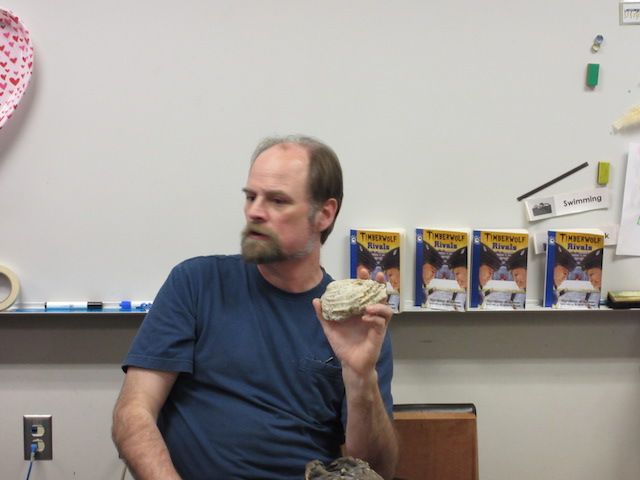
This was where I used a bit of slight of hand. I asked them what else ends up in the mud on the bottom. No guesses so I proceeded to show them a nice piece of fine sandstone from the bottom of the ocean, and thern turned it over to show a fossil fish. My big surprise was that, I’d laid all of my fossils out face down. As I described each kind of sedimentary rock, sandstone, mudstone, limestone, shale, etc, I’d then turn it over to show fossils in that sample. We talked about where each kind of rock would be formed. From that I mentioned where it this one was found and used that to introduce environmental change. I asked if any of them had heard of a place called Egypt. They had and they knew it was a desert. I then described a place in Egypt called the Valley of the Whales, (http://en.wikipedia.org/wiki/Wadi_Al-Hitan), It is a desert now and a long way from the sea but we find hundreds of fossils of whales there so at one time it was under the ocean. I also showed them a fossil clamshell my grandfather collected. He found it on top of a mountain in Nevada but it clearly lived in the ocean meaning that Nevada was lifted up and dried out to form the desert it is now.
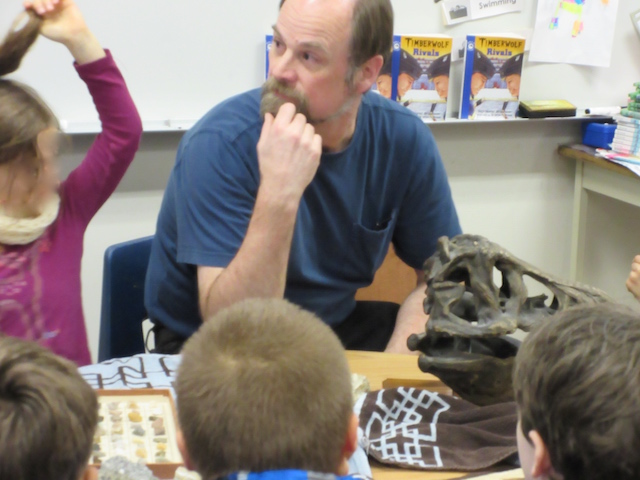
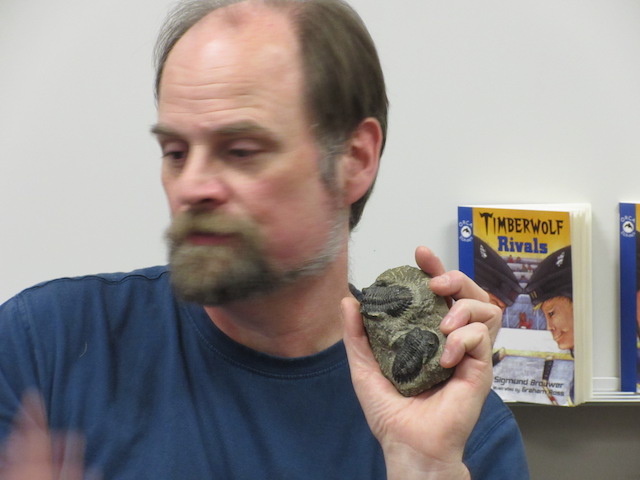
Lastly I mentioned that sometimes we find more than simple shells or bones. This was where I unwrapped my Tyrannosaurus skull. It impressed the heck out of them. OK I didn’t mention that it was a cast not an actual fossil, that point would be moot. It’s also small, about a foot from nose to the back of the head, so it’s not a full grown one either. I went on to describe how long it takes to clean and prepare a fossil and how delicate they were. Along the way I asked them what animals were still around and which ones were extinct. That’s one way of telling how old a rock is. If you find a particular animal in it, and that animal is extinct you know it can’t be any younger than when that animal disappeared. The rock that they found my tyrannosaurus skull in had to be no less than 66 million years old. The rock that holds the two Trilobites had to be at least 450 million years old.
All through this I was answering questions, telling jokes (often more for Mrs. Mullet’s benefit than the kids), and above all keeping it entertaining. The most important thing at this age is to cultivate an interest in science. Particulars can wait until they are older, college age for example. Right now the best thing is to get them thinking about how things work and where they come from. Get them to realize that there is a world outside of this little corner of Vancouver Island. Actually I was impressed. They really picked up on the concepts very well. You can always tell from the class’s questions if you’re loosing them, but they caught on very well. They’re a sharp bunch of kids.
OK and it was a lot of fun.
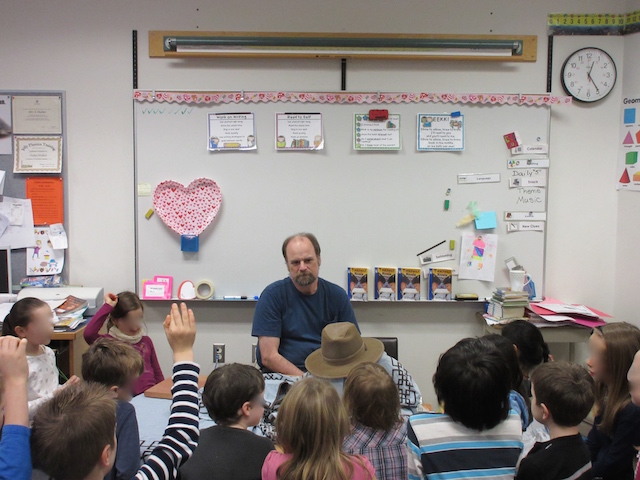
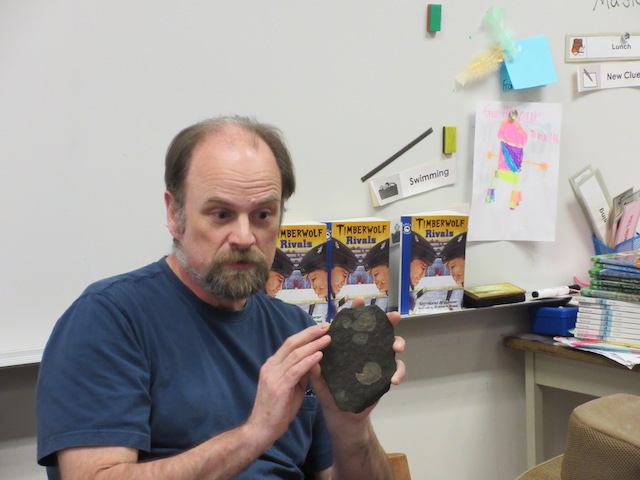
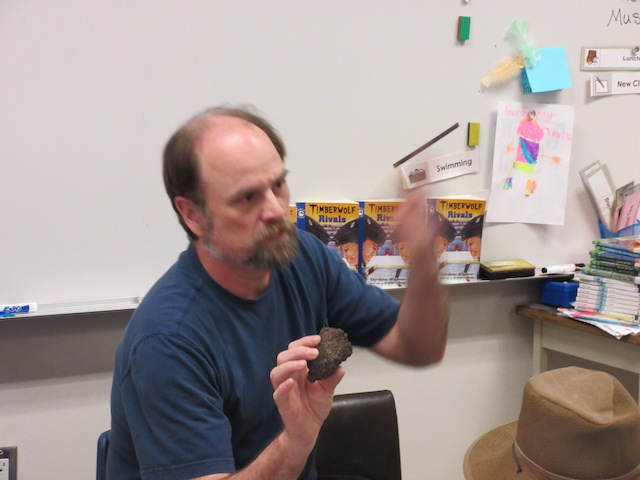
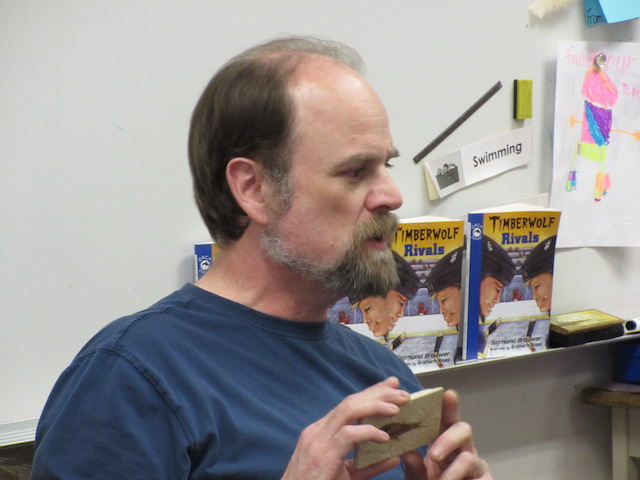
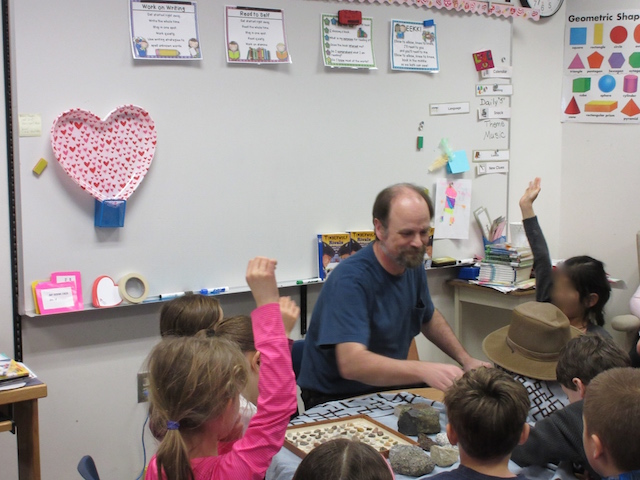
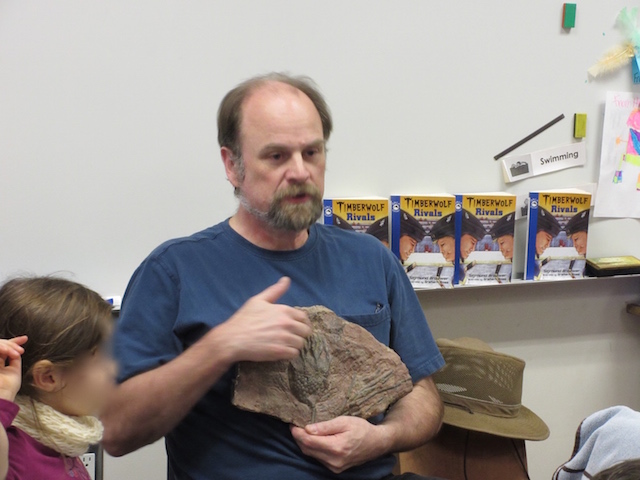
PIX: Doug playing teacher. (Yes I’ve blurred the kids faces where necessary.)
Only then was it mentioned to me.
But I was game for it. First Marsha brought home the class’s collection of rocks. A previous teacher had a shoebox full of nice sample rocks. I classified them and wrote up a description of the rocks and geology in general. Then I pulled out some of my specimens to take with and decided on how I wanted to present everything. You see this isn’t like acting where you have a script to follow. It’s more like 30 or 40 minutes of freeform improv. You have to keep on topic, answer questions, and keep in mind where you want the discussion to go, all while making it informative and funny. It’s actually quite a juggling act. But finally all was ready and we set out.
For work that is. Marsha dropped me off at work. I put in half a day and then at noon Marsha came back to pick me up for the trip to the school. On the way we grabbed a quick bite of lunch. Peanuts and peanut butter on peanut bread with peanut sauce and a side of dry roasted peanuts and a glass of peanut milk. Mwahahahaha!!!!….
Anyway, as we carried all of the boxes of rocks inside two thoughts crossed my mind. The first was; wow rocks are heavy. I mean why couldn’t I have been fascinated by sponges or feathers or air. No, I had to lug around boxes of rocks. Not just any rocks either, fossils which combine the weight of rocks with the delicacy of bone china or crystal. The second thing that crossed my mind was how did Marsha talk me into this? I mean I don’t have a natural affinity for kids. I accept that they exist in the universe. That’s fine, but I don’t normally have much to do with them if at all possible. Especially younger kids who are rather irrational and prone to, um, leakage. Why on earth was I doing this? Oh well, I figured that was just a bit of pre entrance nerves and put it out of my mind. Anyway it was too late to back out.
So we got to Mrs. Mullet’s class, yes that’s her real name, and set up. It’s amazing how kids can be a few feet away, yet if they are paying attention to lunch and the story the teacher’s reading they won’t notice you setting up on a table in the corner of the room. Oh they knew we were there but we were able to set up my surprises and cover everything with towels without anyone really picking up on what we were doing.
Then Mrs. Mullet brought everyone over and I started talking about Geology. My approach is to say that rocks can tell you their story, where they came from, what happened along the way, how they got to where you found them. Geologists just know how to read the rocks, to listen to them tell their story. We talked about igneous rocks, how the ones with he big crystals cooled slowly and the ones without the crystals cooled fast. Then I asked them what happens to a rock that’s sitting outside. I figured this was an easy one as I was pouring rain and they’d just come in from recess. But no I got “birds land on it”, “the sun shines on it”. Finally I got one of them to say something about rain and used that to lead into erosion and how rocks end up getting broken up smaller and wash downstream. They collect as sediment in lakes or the ocean. From that I described how sediment becomes sedimentary rocks.
This was where I used a bit of slight of hand. I asked them what else ends up in the mud on the bottom. No guesses so I proceeded to show them a nice piece of fine sandstone from the bottom of the ocean, and thern turned it over to show a fossil fish. My big surprise was that, I’d laid all of my fossils out face down. As I described each kind of sedimentary rock, sandstone, mudstone, limestone, shale, etc, I’d then turn it over to show fossils in that sample. We talked about where each kind of rock would be formed. From that I mentioned where it this one was found and used that to introduce environmental change. I asked if any of them had heard of a place called Egypt. They had and they knew it was a desert. I then described a place in Egypt called the Valley of the Whales, (http://en.wikipedia.org/wiki/Wadi_Al-Hitan), It is a desert now and a long way from the sea but we find hundreds of fossils of whales there so at one time it was under the ocean. I also showed them a fossil clamshell my grandfather collected. He found it on top of a mountain in Nevada but it clearly lived in the ocean meaning that Nevada was lifted up and dried out to form the desert it is now.
Lastly I mentioned that sometimes we find more than simple shells or bones. This was where I unwrapped my Tyrannosaurus skull. It impressed the heck out of them. OK I didn’t mention that it was a cast not an actual fossil, that point would be moot. It’s also small, about a foot from nose to the back of the head, so it’s not a full grown one either. I went on to describe how long it takes to clean and prepare a fossil and how delicate they were. Along the way I asked them what animals were still around and which ones were extinct. That’s one way of telling how old a rock is. If you find a particular animal in it, and that animal is extinct you know it can’t be any younger than when that animal disappeared. The rock that they found my tyrannosaurus skull in had to be no less than 66 million years old. The rock that holds the two Trilobites had to be at least 450 million years old.
All through this I was answering questions, telling jokes (often more for Mrs. Mullet’s benefit than the kids), and above all keeping it entertaining. The most important thing at this age is to cultivate an interest in science. Particulars can wait until they are older, college age for example. Right now the best thing is to get them thinking about how things work and where they come from. Get them to realize that there is a world outside of this little corner of Vancouver Island. Actually I was impressed. They really picked up on the concepts very well. You can always tell from the class’s questions if you’re loosing them, but they caught on very well. They’re a sharp bunch of kids.
OK and it was a lot of fun.
PIX: Doug playing teacher. (Yes I’ve blurred the kids faces where necessary.)